
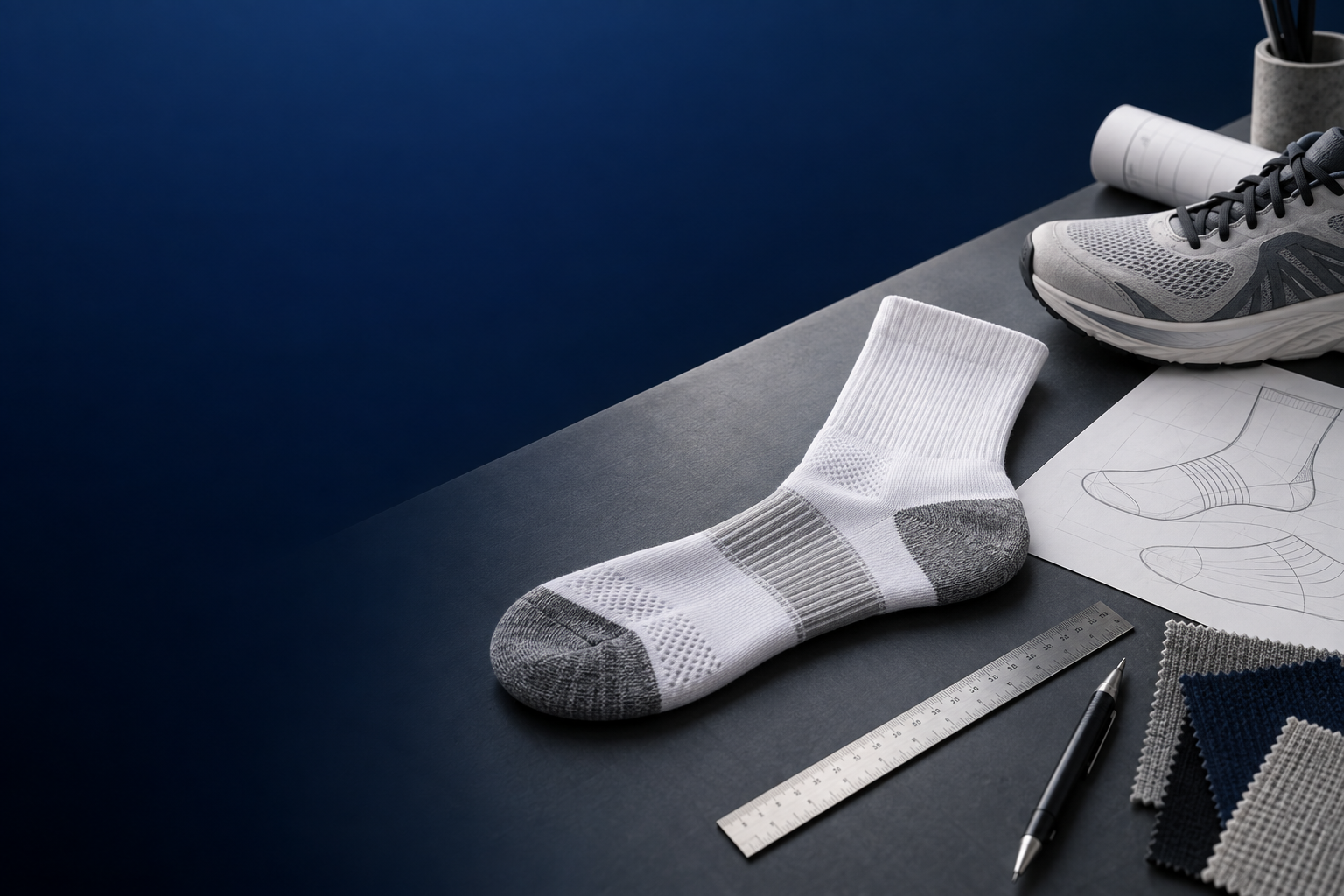
Direct answerSpecify arch support by use case, fixed landmarks, band width, stretch feel, size grading, yarn direction and interaction with mesh, terry and logos. Confirm those decisions on a representative sample and record the approved version before production.
Define the support job before drawing the band
Arch support in a custom athletic sock should begin with a product brief, not a generic claim. Describe the sport, footwear, session length and target wearer. Decide whether the band is intended to create a noticeable wrapped feel, improve product identity, or provide a consistent construction detail across a size range. This keeps the discussion within product development rather than medical advice.
Separate requirements from preferences. A buyer may require a stable visual band and a moderate feel, while color, width or exact yarn remain preferences. List what must be checked on the sample and what the factory may propose. The clearer the decision order, the easier it is to adjust one variable without redesigning the entire sock.
- Sport and footwear
- Target wearer
- Required feel
- Visual requirement
- Open preferences
Place the band using fixed landmarks
Show the band on a flat drawing and reference it to stable landmarks such as the heel turn, sole transition or cuff edge. Avoid instructions like put it under the arch without a measurement or drawing, because foot shapes and sock tension vary. Mark the start, end, width and whether the band continues around the foot.
If the design includes left and right differences, identify them separately. The factory should be able to see where the support structure meets mesh, terry, a logo or a color block. A landmark-based map gives the sample reviewer something specific to measure and makes later revisions easier to communicate.
- Landmark reference
- Start and end points
- Band width
- Left/right difference
- Zone transitions
Specify stretch and comfort expectations
Support bands interact with stretch, yarn and size grading. State the intended feel in practical terms, such as secure without excessive pressure for the target size, and explain how it will be reviewed. The buyer should not promise a medical effect or assume that a tighter band is automatically better.
Review relaxed width, stretch response, recovery and the position of the band while the sock is worn in the intended shoe. Record feedback by size if the range includes men, women, kids or unisex fits. If the band feels too tight or shifts during movement, describe the location and requested change rather than using a broad quality label.
- Target feel
- Relaxed width
- Stretch response
- Recovery
- Size-specific feedback
Coordinate support with mesh and terry
An arch band rarely exists alone. It may cross a mesh area, meet a terry sole or sit beside a logo. Map these relationships so the factory can review transitions and surface changes. A support band that is visually clear on a sketch may become less distinct when it crosses a textured zone or a contrasting color.
Decide which feature has priority if space is limited. For example, a buyer may keep the logo on the leg and move the support band below the logo, or preserve a lighter instep while keeping support under the foot. Write the decision into the construction map and sample comments.
- Mesh interaction
- Terry interaction
- Logo clearance
- Priority order
- Construction map
Choose yarn and elastic direction
Yarn direction and elastic content influence how a support area feels and recovers. Cotton, polyester, nylon, spandex and bamboo blends can be considered according to hand feel, stretch, care expectations and target cost. The factory should flag when a proposed material changes the support feel or the appearance of the band.
Treat substitutions as approval points. Compare the requested and proposed versions on the same size and shoe where practical. Record the accepted material direction, color reference and sample version in the tech pack so a repeat order does not rely on memory or a product nickname.
- Yarn direction
- Elastic response
- Hand feel
- Care expectation
- Substitution approval
Check the band on a representative sample
Use a sample review sheet with band position, width, visual clarity, stretch, recovery, comfort and shoe interaction. Check a representative size first, then confirm whether the grading works across the range. Photograph the sock flat and worn if the project team needs to compare positions remotely.
Separate a construction issue from a fit issue. A band can be correctly placed but feel different because the size or shoe is wrong. Record the test context, sample version and requested action. This evidence helps the factory revise the intended variable rather than guessing.
- Representative size
- Flat measurement
- Worn review
- Shoe context
- Requested action
Document approval and accepted deviations
Approval should identify the sample, drawing and material version. Note any accepted deviation, such as a small visual change needed to keep the band clear across a color transition. If the buyer asks for a revision, keep the earlier version in the change log instead of overwriting it.
This record protects the handoff to sourcing and quality control. It also supports repeat orders when the buyer changes color, quantity or packaging but wants the same support construction. The approved reference should be available with the artwork and measurement files.
- Sample version
- Material version
- Accepted deviation
- Change log
- Approved reference
Turn the brief into a production instruction
The final instruction should connect the use case to measurable choices: support location, landmarks, width, stretch expectation, size grading, yarn direction, mesh and terry relationships, artwork clearance, sample test context and approval owner. This is more useful than calling the product supportive without describing what the factory must build.
For BEZENTO projects, MOQ starts from 300 pairs and final requirements depend on design, materials, construction and packaging. Sampling is about 7 days excluding sample shipping. Keep these commercial facts separate from the support specification and confirm the relevant milestone before ordering.
- Use case
- Band map
- Size grading
- Material direction
- Approval owner
Use a size and grading table
Support details should be reviewed with the planned size range, not only one prototype. Add foot length, cuff height, band position and band width for each size group. State whether measurements are relaxed or stretched and identify the reference point. This gives the factory a repeatable way to review grading.
If the same band is used across men, women, kids or unisex sizes, confirm how its position changes with foot length. A buyer may accept a proportional change, but that decision should be written into the specification and checked on athletic sock specificationss.
- Size groups
- Foot length
- Band position
- Measurement condition
- Grading decision
Give location-based revision feedback
When a sample needs revision, describe the exact location and observation. Examples include the band sitting above the intended arch, feeling tight in one size, becoming unclear beside a logo, or shifting when worn in the shoe. Add the requested direction and whether the change applies to every size.
Avoid combining several variables in one request. If the factory changes yarn, band width and mesh at the same time, the buyer cannot tell which change solved the issue. Review one construction variable at a time where the launch schedule allows and update the sample version after each decision.
- Exact location
- Observed issue
- Requested direction
- Size scope
- Sample version
Keep support claims evidence-based
Describe arch support as a construction and fit choice. The article can teach buyers how to specify a band and review its feel, but it should not promise injury prevention, therapeutic benefit or a universal performance outcome. Those claims require separate evidence and approval.
A professional product brief states what the buyer will inspect: position, width, stretch, recovery, comfort, visual clarity and interaction with the shoe. This language is useful for sourcing and quality teams and keeps the approved sample aligned with what was actually reviewed. Keep this wording consistent across the tech pack, quotation, sample comments and final inspection sheet so every team member reviews the same requirement. This improves handoff quality when a project moves from design review to purchasing, inspection and repeat ordering, especially when colors, quantities or packaging change later. A dated version and named approver make the decision auditable for the whole supply chain. during final production checks and repeat orders.
- Construction language
- Fit observation
- Review evidence
- No medical promise
- Approved wording
Buyer Questions
Is arch support a medical feature?
Treat it as a product construction feature and describe the intended feel and placement. Avoid medical claims unless separately supported and approved.
How should buyers show the support location?
Use a flat drawing with fixed landmarks, start and end points, width and any left/right difference.
Can the support band cross a logo or mesh zone?
It can be considered, but map the interaction and confirm legibility, texture and comfort on the sample.
How do buyers review support across sizes?
Check a representative size, then confirm the band position, feel and grading across the planned size range.
What should be approved before bulk production?
Approve the sample version, band location, width, material direction, size behavior, accepted deviations and review evidence.
Discuss Your Custom Sock Requirements
Send your product type, artwork, quantity, size range, packaging, destination and target date for a practical project review.