
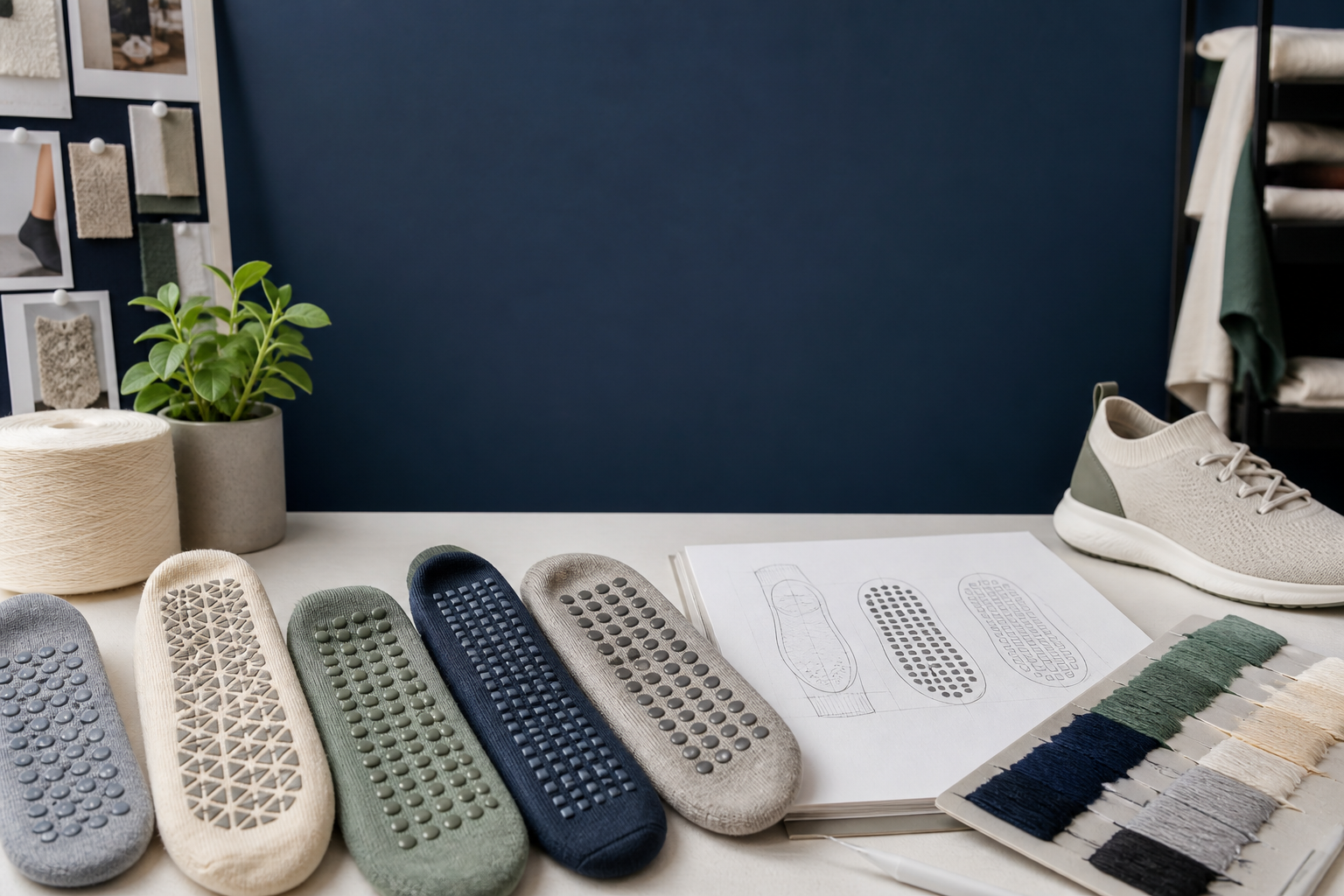
Direct answerEvaluate a grip sock logo as part of the full applied pattern, not as artwork alone. Review the material and attachment process, logo scale, pattern edges, stretch, sole placement, cleaning instructions and a project-specific inspection method. Without an agreed test method and acceptance standard, it is not responsible to promise a fixed number of washes or a universal durability result.
Define what durability means for the product
Durability can refer to attachment, edge integrity, legibility, color appearance, flexibility or resistance to the intended cleaning routine. These are related but different observations, so a buyer should define which ones matter for the product and use case. Grip sock logo durability should be written as observable checks rather than a broad service-life promise.
A studio sock, team product and retail multipack may have different priorities. State the expected surface, wear pattern, care routine and visual standard before asking the supplier to recommend a check.
- Logo remains attached
- Edges stay consistent
- Pattern remains recognizable
- Applied area does not become unnecessarily rigid
- Color and texture remain within the agreed reference
- Care instructions match the approved product
Start with artwork that can survive the process
Fine lines, small letters and tightly packed details can be difficult to reproduce in an applied sole pattern. The artwork should be reviewed at the actual production scale, with the pattern spacing and stretch in mind.
Ask the factory to identify any simplification before sampling. Record the approved interpretation rather than comparing bulk output to a screen mockup that was never production-ready.
- Minimum line and gap size to be confirmed
- Logo dimensions and orientation
- Pattern density around the mark
- Color separation
- Acceptable simplification
- Approved vector or production file
Check placement, edges and attachment on the sample
A logo can look clear in the center of a flat sole and behave differently near a curve, edge or high-flex area. Inspect the boundary between textile and applied material, and check that the intended sole zones are covered consistently.
The sample should be reviewed relaxed and stretched. Look for lifting edges, missing areas, uneven thickness, contamination or pattern drift. These observations should be converted into a written acceptance checklist for bulk inspection.
- Coverage and location
- Edge consistency
- Attachment to the textile
- Uneven thickness or gaps
- Pattern alignment across the pair
- Behavior when stretched
Separate a visual review from a durability test
A visual sample review can identify placement and construction issues, but it does not establish a service-life claim. If the buyer needs a wash, abrasion or flex test, define the method, sample count, cleaning conditions, inspection points and pass criteria before the test begins.
Do not publish a wash-count or long-term performance number without a traceable method and result. The correct test depends on the applied material, sock construction, care instruction and intended market.
- Test method and equipment
- Sample count and product version
- Cleaning or flex conditions
- Inspection intervals
- Pass/fail criteria
- Record owner and test date
Align care instructions with the approved construction
Care instructions should be based on the actual product and approved process. A change in grip material, attachment, textile blend or finishing can change what care guidance is appropriate.
The buyer or responsible marketer should confirm market requirements and claims. The factory should manufacture the approved product and flag changes that could affect the agreed care direction.
- Approved material and process
- Care method supported by the product
- Warnings for harmful procedures
- Label and packaging consistency
- Change-control for substitutions
Document the bulk inspection standard
Before bulk production, create a visual standard with the approved sample, sole map, logo file, colors, placement and acceptance examples. Tell the factory how to handle missing grip, edge variation, incorrect orientation, logo distortion or product mix-ups.
BEZENTO's standard sampling estimate is about 7 days, excluding sample shipping time. Bulk production is typically about 25–35 days after the relevant approvals and order requirements are confirmed. Include the inspection and approval milestones in the same order record.
Separate critical defects from appearance variations that the buyer has agreed to accept. A critical defect might be an incorrect logo orientation, missing applied material in a required zone or a mixed size. An appearance variation should be described with a reference example rather than an undefined request for perfection.
For a repeat order, compare the production sample with the retained approved reference under the same viewing conditions. Record the product version, inspection date, reviewer and any accepted deviation. This creates a traceable standard without claiming that every product will look identical in every condition.
- Approved sample and artwork version
- Grip and logo placement map
- Defect examples
- Measurement or tolerance points
- Packing and assortment checks
- Escalation and rework process
Choose a test only when the decision requires one
Not every logo project needs the same test. A visual review may be enough to approve scale, placement and edge appearance, while a studio product with repeated cleaning may require a defined wash or flex check. Select the test from the intended use and the risk the buyer needs to manage.
Write the method before testing begins: product version, sample count, cleaning or flex conditions, inspection intervals, equipment, photographs and pass criteria. If the test is comparative rather than a formal standard, label it as an internal comparison and avoid presenting the result as a universal service-life claim.
When a result does not meet the agreed criterion, record the failure location and likely cause. The next sample may require a change to logo scale, pattern spacing, placement, applied material or care instruction. Review the full sole map rather than changing one visible area without checking the surrounding construction.
- Use-case risk
- Defined method
- Product version and sample count
- Inspection intervals
- Pass criteria
- Failure record and corrective action
Choose a test only when the decision requires one
Not every logo project needs the same test. A visual review may be enough to approve scale, placement and edge appearance, while a studio product with repeated cleaning may require a defined wash or flex check. Select the test from the intended use and the risk the buyer needs to manage.
Write the method before testing begins: product version, sample count, cleaning or flex conditions, inspection intervals, equipment, photographs and pass criteria. If the test is comparative rather than a formal standard, label it as an internal comparison and avoid presenting the result as a universal service-life claim.
When a result does not meet the agreed criterion, record the failure location and likely cause. The next sample may require a change to logo scale, pattern spacing, placement, applied material or care instruction. Review the full sole map rather than changing one visible area without checking the surrounding construction.
A useful test record distinguishes the observation from the decision. For example, note that an edge lifted after a defined flex or wash condition, then state whether the result is rejected, accepted with a care instruction or sent for another sample. This keeps the quality decision clear without implying that one test predicts every use environment.
If the logo is part of a larger grip pattern, inspect nearby grip areas at the same time. A logo may remain legible while a surrounding edge, gap or transition changes the way the pattern looks or flexes. The approved standard should cover the complete visual and construction relationship, not only the most noticeable mark.
- Use-case risk
- Defined method
- Product version and sample count
- Inspection intervals
- Pass criteria
- Failure record and corrective action
Create a repeat-order control plan
A durability standard is most useful when it can be applied to the next order. Keep the approved artwork, sole map, material direction, sample photographs and inspection examples together. Record which changes require a new sample, such as a different grip material, logo size, sole coverage or care instruction.
Before a repeat order enters bulk production, compare the new sample with the retained reference and confirm that the product version is unchanged. If a substitution is proposed, ask the supplier to identify the reason, affected areas and required re-approval instead of treating the change as an equivalent replacement.
During packing, include pair matching, size, orientation and logo placement in the inspection. A durable logo on the wrong size or reversed pair is still a customer-facing quality issue. The final record should show who inspected the product, which version was used and how exceptions were handled.
- Retained master sample
- Change triggers for re-sampling
- Substitution review
- Pair and size matching
- Inspection record and exceptions
Buyer Questions
Can a grip sock logo be stated to last a certain number of washes?
Only a project-specific test can support a defined performance statement. Agree on the method, product version, care conditions and pass criteria before using a wash-count claim.
What commonly causes a grip logo problem?
Small details, unsuitable scale, high-flex placement, inconsistent attachment, uneven edges, material changes and unclear approval references can all create quality issues.
Should I approve a grip logo from a digital mockup?
Use the mockup to communicate intent, but approve the actual production interpretation on a physical sample and record the accepted version.
How do I inspect a grip sock logo?
Check coverage, placement, edges, attachment, thickness, orientation, pair matching and behavior when the sock is relaxed and stretched. Use a documented standard for bulk inspection.
What should be recorded for a durability test?
Record the method, sample count, product version, care or flex conditions, inspection intervals, pass criteria, test date and responsible reviewer.
Discuss Your Custom Sock Requirements
Send your product type, artwork, quantity, size range, packaging, destination and target date for a practical project review.