How to Approve Custom Sock Logo Placement Before Production
Direct answer
Approve a custom sock logo only after the supplier has confirmed four things in the same sample: the logo position, the finished size, the decoration method and the way the artwork behaves when the sock is worn. A file that looks correct on a flat design board can move, stretch or lose detail on a knitted surface.
For a reliable approval, record the logo reference from a fixed point on the sock, specify the finished dimensions rather than only the artwork file size, and review the logo on the actual sock construction and size range. Do not approve from a digital mock-up alone.
Why logo placement needs a production decision
Logo placement affects more than appearance. It can change how a team sock is read from a distance, whether a private-label mark is visible in retail packaging, and how much distortion appears when the fabric stretches around the leg or foot.
The correct location also depends on the buyer's use case:
| Buyer situation | Main placement question | What should be approved |
|---|---|---|
| Team or club socks | Can the mark be identified while the sock is worn with footwear or a uniform? | Position, orientation, colour contrast and size across the agreed size range |
| Private-label retail socks | Will the brand mark remain recognisable on the folded or packaged pair? | Placement, repeat direction, finished dimensions and packaging presentation |
| Event or promotional socks | Is the mark readable at the intended viewing distance? | Simplified artwork, contrast and the visible face of the sock |
| Athletic or performance programmes | Does the mark avoid the main stretch, friction or cushioning zones selected for the brief? | Location, method, edge definition and sample behaviour |
This table is a starting point, not a universal rule. The final choice should follow the approved brief and sample.
Step 1: Define the visible face of the sock
Before discussing the logo file, identify the side the buyer expects people to see. “Front of sock” can mean different things for an ankle sock, crew sock, knee-high team sock or a sock with a planned cuff stripe.
Write the reference in plain language, such as:
- centred on the outer leg;
- aligned below the cuff rib;
- placed on the instep;
- repeated on both sides of the pair; or
- positioned on the sole, where the mark is intended for packaging rather than everyday visibility.
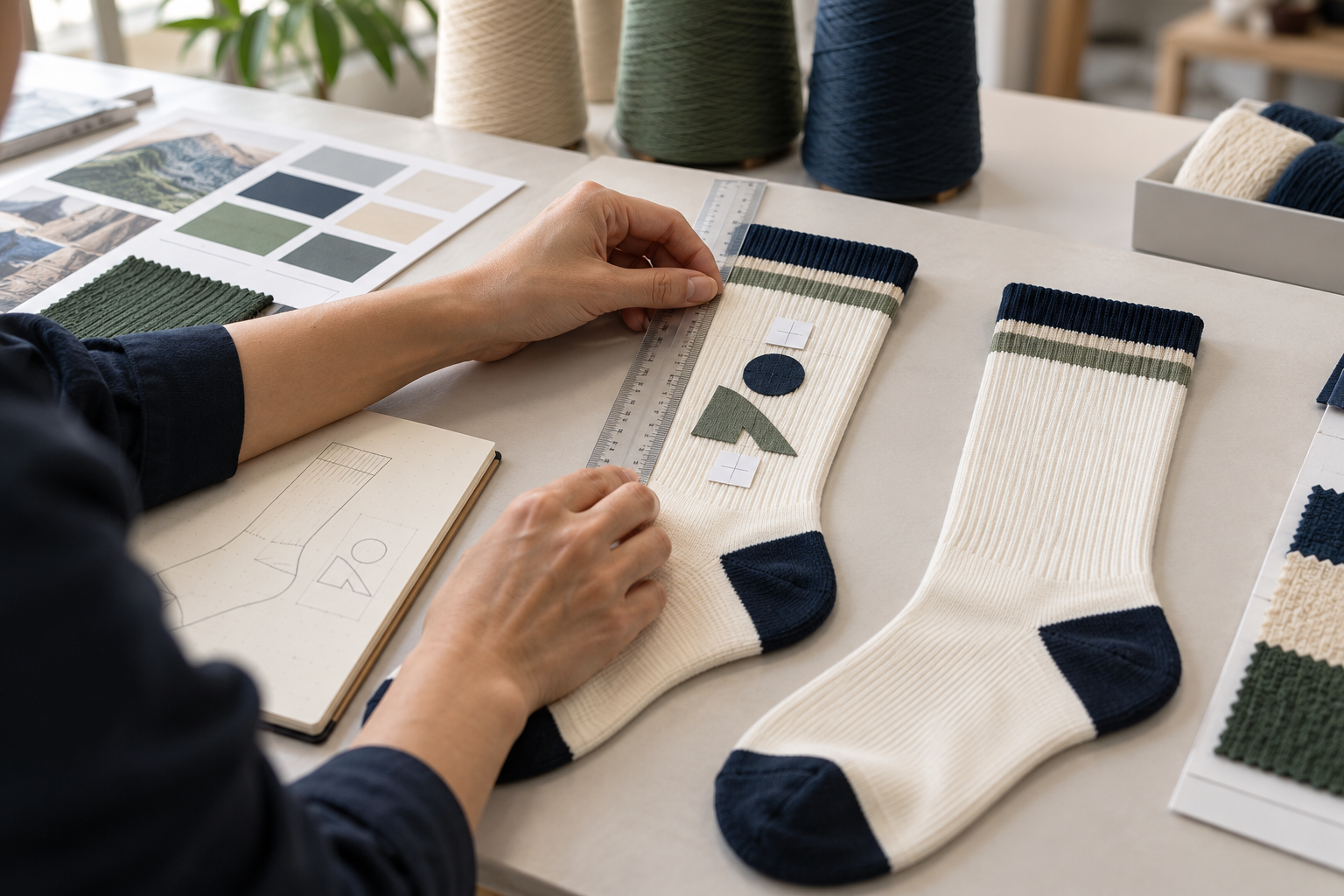
Add a simple annotated sketch or a marked sample photo. The sketch does not need to be a finished design; it needs to remove ambiguity about orientation and the reference point.
Step 2: Specify finished dimensions, not only artwork dimensions
The artwork file may be supplied at a large resolution, but production needs the intended finished width and height on the sock. Record both dimensions and state whether the measurement is taken on the relaxed sock or on the approved sample.
Also record:
- the minimum readable detail in the mark;
- the clear space around the mark;
- whether the mark is allowed to be proportionally scaled; and
- whether the same finished size applies to every sock size.
For a size run, do not assume that one logo measurement is automatically correct. A mark that looks balanced on a small sample may look undersized on a larger leg, while a fixed-size mark may become crowded on a smaller sock. Ask the supplier to show the proposed grading or confirm that one size is intentionally used across the range.
Step 3: Match the logo method to the artwork
The decoration method should be selected after reviewing the artwork and the sock construction. Buyers commonly need to decide between knitted-in artwork, printing, embroidery or another method offered for the project. Each method has different limits for fine lines, small text, colour changes, stretch and surface feel.
Use this decision sequence:
| Artwork characteristic | Question for the supplier |
|---|---|
| Fine lines or small lettering | Will the smallest details remain distinct at the finished size? |
| Several colours | How will colours be separated and approved? |
| A mark crossing a stretch zone | Will the artwork be reviewed on a worn or stretched sample? |
| A simple one-colour mark | Can the method preserve clean edges without adding unnecessary complexity? |
| A mark near a cuff, heel or toe | Does the local construction affect alignment or readability? |
Avoid choosing a method only because it looks good in a flat computer mock-up. The sample must be the deciding reference.
Step 4: Review the logo on the actual sample
When the sample arrives, inspect it in the same states that matter to the buyer:
- laid flat for centring and orientation;
- worn or gently stretched for distortion;
- folded as it will appear in packaging;
- viewed from the intended distance; and
- compared as a left/right pair.
Do not judge colour under only one light source if colour contrast is important. Record the approved colour reference and the tolerance for an acceptable production variation in the project file. If the colour reference is not yet defined, mark it as pending rather than treating the screen image as the final standard.
Step 5: Check size grading and pair consistency
Approval is incomplete if only one sample is checked. Ask how the logo will be handled across the agreed size groups and whether the position is measured from the same construction point on every size.
The approval set should confirm:
- logo size by size group;
- distance from the cuff, heel, toe or other reference point;
- vertical and horizontal alignment;
- left/right pair matching;
- orientation after knitting and finishing; and
- the version of the artwork used for production.
If the buyer changes the sock height, cuff depth, stripe layout or size range after approval, reopen the logo approval. A change in the base construction can change the correct position even when the artwork file stays the same.
Common approval failures
Approving a mock-up instead of a sample
A digital mock-up cannot show every effect of stretch, knitting, finishing and folding. Use it for direction, then approve the physical sample.
Giving a position without a reference point
“Put it near the top” is not a production instruction. State the distance from a defined edge or construction feature.
Locking one logo size for every sock size
This may be correct for a deliberately uniform programme, but it should be an explicit decision. Otherwise, review the visual balance across the size run.
Sending several artwork versions
Multiple files create avoidable version risk. Name one production artwork file and record its date or revision in the approval message.
Hiding small text inside the mark
If the lettering is not readable at the finished size, simplify it or move it to a more suitable placement. Do not rely on a buyer discovering the problem after bulk production.
Custom sock logo approval checklist
Before production, confirm:
- The visible face and orientation are defined.
- The position is measured from a clear reference point.
- Finished logo width and height are recorded.
- The decoration method is agreed for the artwork and sock construction.
- Colour references and contrast expectations are documented.
- The physical sample has been reviewed flat, stretched and folded where relevant.
- Size grading or one-size treatment is approved.
- Left/right pair alignment is checked.
- One final artwork revision is identified for production.
- Any change to height, cuff or size range triggers a new review.
Frequently asked questions
Should a logo be placed on the cuff or the leg?
There is no single correct answer. The choice depends on visibility, cuff construction, artwork size, use case and how the pair will be folded or worn. Compare both positions on the actual sample.
Can the same logo size be used for all sizes?
It can be, if a consistent programme look is the priority and the sample review confirms acceptable balance. Otherwise, agree a size-group adjustment before production.
What should I send with the logo file?
Send the final artwork, preferred colours, intended logo position, finished dimensions, size range and any restrictions on scaling or simplification. If the artwork is still being developed, label it as a reference rather than final production art.
Is a screen mock-up enough for approval?
No. A screen mock-up is useful for direction, but physical sample approval is needed to review stretch, surface, alignment and pair consistency.
What happens if I change the sock design after logo approval?
Recheck the logo whenever the sock height, cuff, stripe layout, size range or construction changes. The previous approval may no longer match the new base.
Related resources
- What Artwork Files Are Needed for Custom Logo Socks?
- Custom Sock Logo Methods: Jacquard vs Embroidery vs Print
- What Should You Confirm Before Sampling Custom Socks?
- Custom Logo Socks
Final thoughts
Logo approval is a production control, not just a design preference. Define the reference point, finished dimensions, method, size treatment and sample checks in one approval record. This gives the buyer and supplier the same visual standard before knitting begins and makes later quality review much easier.