Direct answerChoose the logo method from the artwork, sock construction, placement, stretch, desired surface effect and intended use. Jacquard integrates the design into the knit, embroidery adds a raised applied mark, and printing is considered when the artwork needs surface detail that knitting may not reproduce cleanly. The final method should be approved on a physical sample rather than selected from appearance alone.
Start with the artwork and intended use
A logo method is not an isolated decoration choice. The artwork has to work with the sock's yarn, gauge, rib structure, cushioning, stretch and placement. A mark that looks clear on a flat screen can change when it is translated into knitted stitches or stretched around the leg.
Begin by identifying what must remain recognizable. For some brands that is a simple silhouette or two-color symbol. For others it is fine lettering, a gradient or a highly controlled surface finish. Also define where the mark will sit and whether it must be visible while the sock is worn with footwear.
- Supply editable artwork where possible
- Specify the intended logo dimensions and placement
- Provide color references and a visual mockup
- Explain which details may not be simplified
- Identify the sock's use, construction and expected stretch
Jacquard knitting integrates the logo into the sock
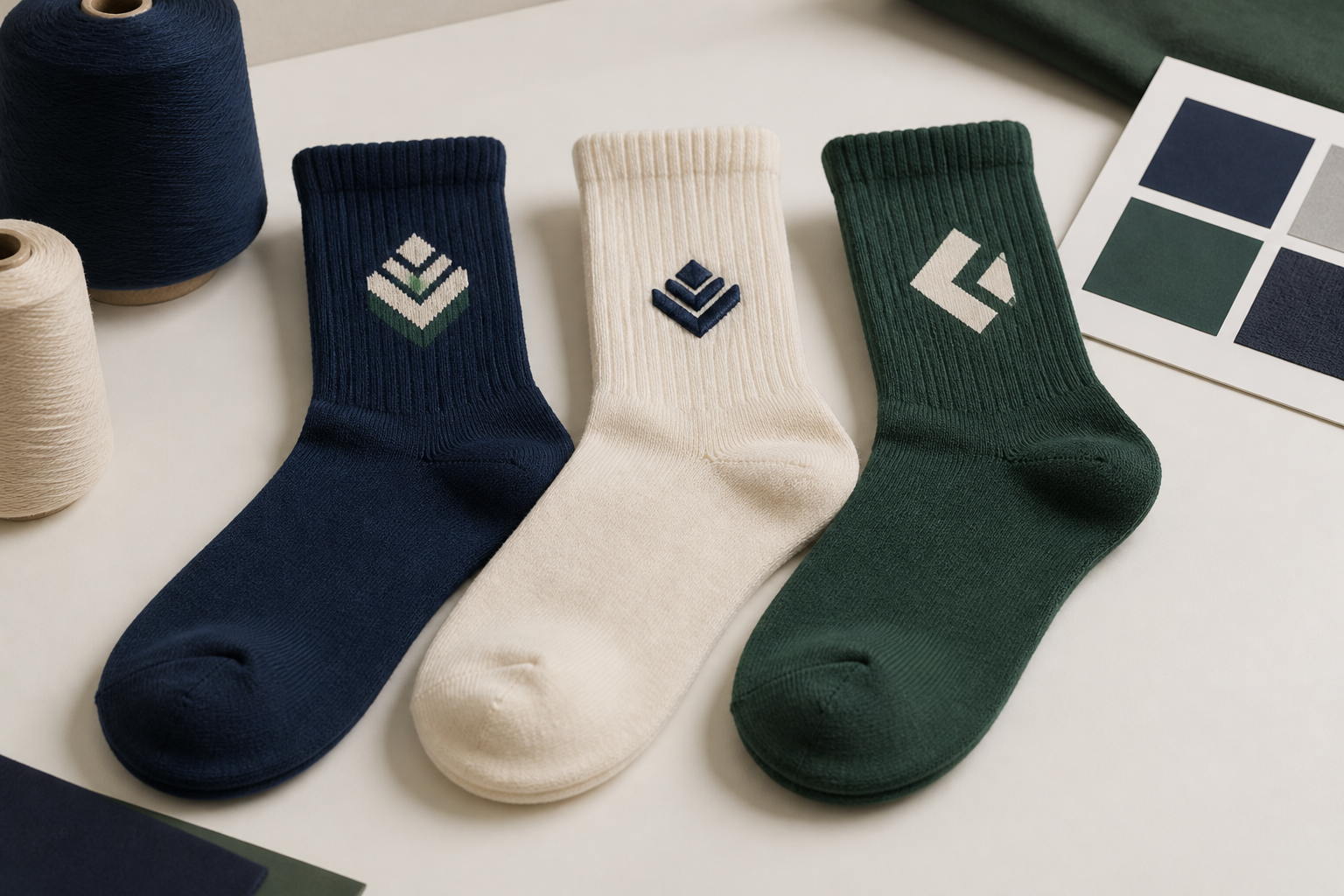
With jacquard, the logo is formed during knitting rather than added after the sock is made. This can create a cohesive appearance because the design is part of the fabric. It is often a practical direction for geometric marks, repeated motifs, bands and simplified lettering.
The artwork still has to follow the logic of stitches. Very small gaps, thin lines and tightly spaced letters may merge or lose clarity. The reverse side of the design also matters because carried yarn can affect stretch and comfort. A production review should consider both the outside appearance and the inside construction.
Jacquard is not automatically the correct answer for every simple logo. Gauge, yarn thickness, ribbing and the amount of stretch at the selected location can change the result. Review the logo at its actual production size and on the intended sock construction.
- Useful when the design should feel integrated with the knit
- Works more reliably after artwork is adapted to stitch resolution
- Requires review of stretch, yarn floats and reverse-side construction
- Color and detail decisions should be confirmed on the sample
Embroidery creates a raised applied mark
Embroidery adds thread to a finished or partially finished sock, producing a more raised and localized logo. It can give a badge-like appearance and can separate the mark visually from the knitted ground.
The additional thread also changes thickness and flexibility in that area. Large, dense embroidery may feel stiff, particularly where the sock must stretch or sit closely against the skin. Placement should therefore be assessed for both visibility and comfort.
Small text is not automatically easier in embroidery. Letter height, stitch density, spacing and fabric stability all influence legibility. A clean digital file should be converted into an embroidery interpretation and tested at the real size.
- Creates a raised, dimensional appearance
- Usually evaluated as a localized mark rather than a large all-over treatment
- Density and placement can affect flexibility and comfort
- A physical sample is needed to approve edge quality and legibility
Printing supports a different type of surface detail
Printing places artwork on the sock surface and may be considered when the design calls for detail, tonal changes or an effect that is difficult to express through knitted stitches. The workable printing route depends on the fiber blend, sock construction, artwork, coverage and production process.
A sock is a flexible three-dimensional product, not a flat sheet. Artwork can look different around curves, ribbing, heel transitions and high-stretch zones. The evaluation should include alignment, coverage, color appearance and how the print behaves when the sock is worn.
Because printing types and compatibility vary, buyers should avoid specifying only the word ‘printed.’ Send the full design and ask the factory to confirm the proposed process, limitations and sample expectations for that particular product.
- Useful for artwork that needs surface detail beyond stitch resolution
- Compatibility depends on material and construction
- Placement must account for curves and stretch
- Color, hand feel and durability require project-specific approval
Compare methods with a production decision table
The table below is a starting framework, not a substitute for sampling. The same logo can require a different method when the sock material, gauge, placement or target appearance changes.
- Integrated knitted appearance: review jacquard first
- Raised localized emblem: review embroidery first
- Detailed surface artwork: review a compatible printing route
- Sole traction or grip branding: review the grip application separately
- Uncertain artwork: ask for two sample interpretations before committing to bulk
Approve the sample against written criteria
Do not approve a logo only by saying that it looks good. Record the method, dimensions, position, colors and any accepted simplification. Inspect the sock both relaxed and stretched, and check whether the inside construction affects wearability.
BEZENTO's standard sampling estimate is about 7 days, excluding sample shipping time. Revisions, special materials or complex construction may require additional time. Bulk production is typically about 25–35 days after the relevant approvals and order requirements are confirmed, although the exact start point and project scope should be stated in the quotation.
MOQ starts from 300 pairs with flexible color and size combinations. Final requirements should still be confirmed against the design, materials, construction and packaging. This makes the artwork review important: simplifying a mark before sampling can be more efficient than discovering a legibility problem after production planning has begun.
- Check relaxed and stretched appearance
- Confirm logo size and distance from construction lines
- Review the inside of knitted or embroidered areas
- Record approved colors and acceptable tolerances
- Keep the approved sample and written specification as shared references
Buyer Questions
Which logo method should I choose for custom socks?
There is no universal method for every design. Jacquard, embroidery and printing create different appearances and interact differently with the sock's stretch, construction and placement. Review the actual artwork and approve a physical sample.
Can a detailed logo be knitted into a sock?
Some detail may need to be simplified to suit stitch resolution, yarn and gauge. Thin lines, small gaps and compact lettering should be tested at the intended production size.
Does embroidery make a sock less flexible?
Dense embroidery can add thickness and reduce flexibility in the applied area. The effect depends on logo size, stitch density, placement and the sock beneath it.
Can printed artwork wrap around a sock?
The proposed printing process and artwork placement must be reviewed against the sock's curves, seams, material and stretch. A sample should confirm alignment and appearance.
Can colors and sizes be combined within the MOQ?
BEZENTO's MOQ starts from 300 pairs, and colors and sizes may be combined flexibly. Final requirements remain subject to product and design review.
Discuss Your Custom Sock Requirements
Send your product type, artwork, quantity, size range, packaging, destination and target date for a practical project review.