
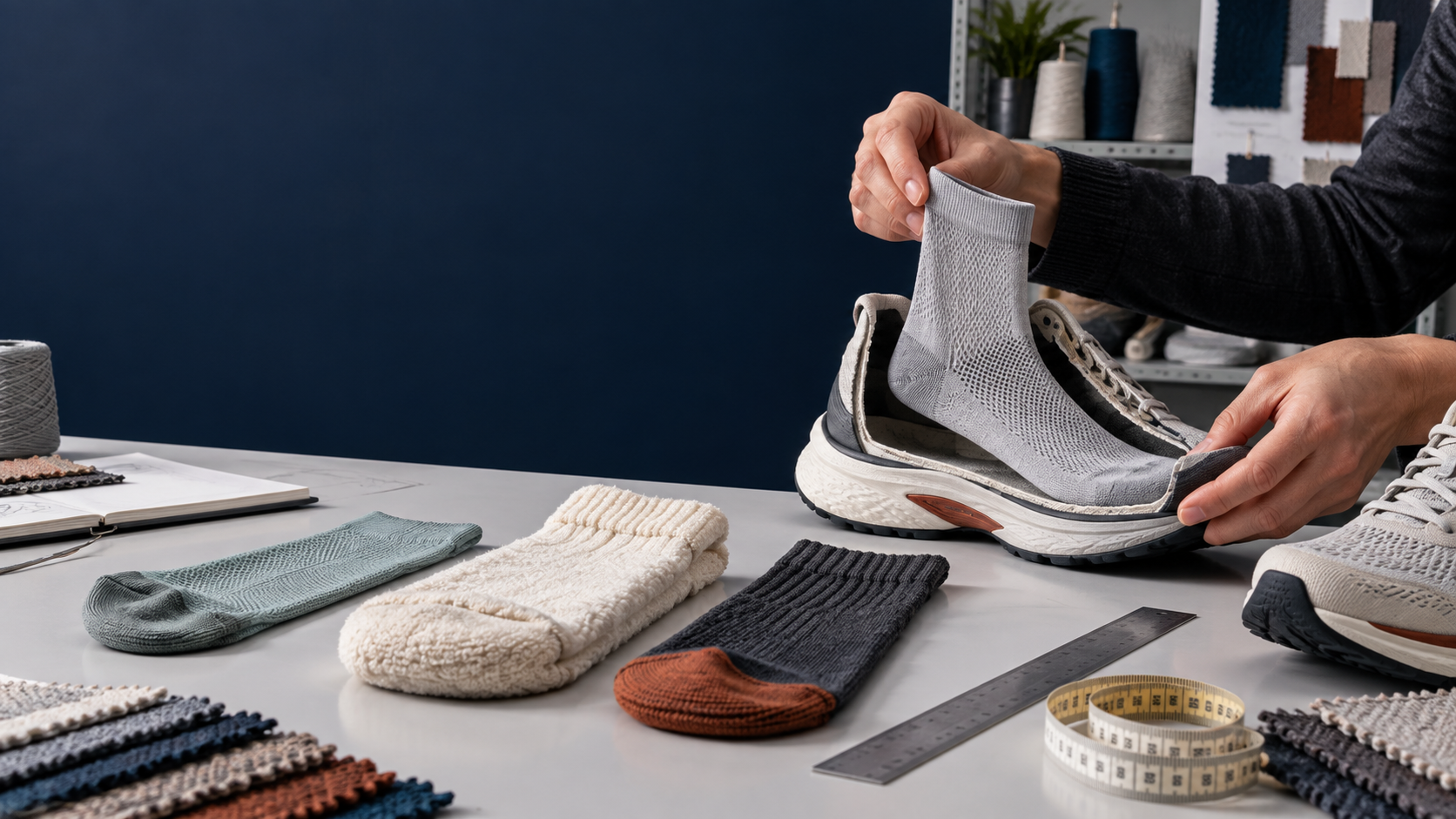
Direct answerSpecify custom sock thickness as a construction outcome rather than a vague label such as light or heavy. Define the intended shoe, activity, yarn direction, knit density, cushion zones, measurement method and acceptable range, then review representative samples in the actual footwear. Thickness affects space, warmth, hand feel, drying expectations and production consistency, so it should be approved together with size and construction.
Treat thickness as a construction decision
Thin, midweight and thick are useful directions, but they are not complete specifications. A sock can feel thick because of terry loops, dense yarn, a reinforced zone, a ribbed cuff or a finishing treatment. A buyer should describe the intended result and identify which zones need more or less material.
Start with the use case and footwear. A running sock, studio sock, winter lifestyle sock and team product may share a visual style but have different priorities for shoe clearance, warmth, ventilation and cushioning. The factory needs to know the context before recommending a construction.
Record the thickness decision beside the yarn and construction map. If the product has a thin mesh versus terry cushion instep and a cushioned sole, do not assign one word to the whole sock. Use a zone map so the sample can be checked against the same intent.
- Use case
- Target footwear
- Yarn direction
- Zone-by-zone construction
- Intended hand feel
Connect thickness to shoe fit
The most important fit question is whether the finished sock works inside the intended shoe. Extra material in the sole, toe or instep can change foot volume and pressure, while a very light construction may not provide the hand feel or coverage the product brief expects. Review thickness with the shoe rather than only in the hand.
Use the correct size and the actual or representative footwear during sample review. Check the toe area, ball of the foot, heel pocket and instep separately. Note whether the sock bunches, slides, creates pressure points or changes the way the foot sits in the shoe. These observations are more useful than a general statement that the sock feels too thick.
If the product will be worn with more than one shoe model, define the primary shoe and the acceptable range for other models. A construction optimized for a roomy training shoe may feel different in a close-fitting racing shoe. The decision should be tied to the launch use case.
- Actual shoe model
- Toe and forefoot
- Heel pocket
- Instep clearance
- Primary use case
Map cushion and ventilation zones
Thickness is rarely uniform. A buyer can specify a lighter mesh versus terry cushion area on the instep, a denser sole, a terry forefoot or reinforcement at heel and toe. The map should show where the construction changes and what the reviewer must observe in each zone.
Compare cushion depth, loop density and surface texture rather than using the word cushion alone. Mesh affects air movement and stretch, while terry adds a different surface and volume. The factory can recommend a workable combination, but the buyer should approve the actual balance on the sample.
Link the map to the artwork and logo placement. A logo over a dense terry area may require a different size or location than the same logo on a smooth leg. A change made for thickness can therefore affect appearance and must be reviewed across the complete product.
- Mesh zones
- Terry or cushion zones
- Heel and toe reinforcement
- Surface texture
- Logo interaction
Specify yarn and knit settings by outcome
Yarn choice, yarn count direction, stitch density, terry depth and finishing all influence the finished thickness. Buyers do not need to dictate every machine setting, but they should ask the factory to explain which settings create the proposed result and which changes would alter fit or hand feel.
Avoid assuming that a fiber percentage predicts thickness. The same nominal blend can be knitted into different weights and structures. Ask for the material version, construction notes and any planned substitution, then reassess the sample if one of those inputs changes.
A practical brief states what must be measured or compared: relaxed thickness, stretched behavior, cushion zone, weight direction or a hand-feel reference. The method should be consistent between development and inspection so a later production decision is understandable.
- Material version
- Yarn construction
- Knit density
- Terry depth
- Measurement or comparison method
Review warmth and moisture expectations carefully
A thicker construction can change warmth, surface feel and drying expectations, but thickness alone does not prove a performance result. Climate, shoe ventilation, fiber choice, finishing, activity and care all matter. Keep the article and product brief focused on what can be checked in the approved sample.
Ask the factory to describe the intended trade-off: more coverage, a denser sole, a warmer hand feel or a different surface. If a buyer needs a specific thermal or moisture result, define the test method and evidence separately instead of turning a construction description into a universal claim.
Include care and use conditions in the review notes. Washing, drying and repeated wear can change the hand feel or dimensions, so the buyer should confirm which care instruction belongs to the final product and packaging.
- Climate and activity
- Shoe ventilation
- Surface and hand feel
- Care instruction
- Evidence required for performance claims
Use a representative size for approval
A thickness decision made on one prototype does not automatically prove that every size will feel the same. Review a custom sock sample checklist and ask how the construction will grade across the range. Foot length, cuff height, mesh versus terry cushion placement and cushion zones may need proportional changes.
Check at least the size boundaries that create the greatest fit risk for the launch. Record which size was used for the shoe test, whether the sock was relaxed or worn, and which dimensions were compared. A repeatable record makes the next sample easier to evaluate.
If men’s, women’s, kids’ or unisex ranges share a design, confirm whether the same thickness direction applies to all. A proportional grading decision may be acceptable, but it should be written into the specification rather than assumed.
- Representative size
- Size boundaries
- Grading approach
- Worn or relaxed condition
- Approved range
Confirm production consistency and inspection points
Before bulk production, convert the thickness direction into inspection points. Confirm the approved sample version, measurement locations, construction zones, acceptable variation and the person who approves a deviation. The inspector should be able to see which area is being checked and why it matters.
Do not combine thickness with unrelated defects. A sock may have the intended volume but still show a wrong color, uneven logo, poor pairing or a measurement outside the agreed range. Keep each issue separate so the factory can propose the right corrective action.
Ask how a material or machine change will be handled. If yarn, density, terry depth, finishing or size grading changes after approval, request a review before assuming the original thickness approval still applies. Store the approved sample and measurement record for repeat orders.
- Sample version
- Measurement locations
- Zone-specific range
- Deviation owner
- Change-control trigger
Build a buyer-facing thickness checklist
Before sending a quote or sample request, include the activity, shoe, target sizes, yarn direction, zone map, cushion and mesh versus terry cushion locations, logo interaction, care assumptions and approval method. This gives the factory enough context to propose a practical construction without hiding decisions inside a vague adjective.
When the sample arrives, review fit first, then construction, appearance and care information. Record the exact location of any revision and state whether the change applies to every size. Avoid changing yarn, thickness and artwork at the same time when the schedule allows; otherwise the next sample will be difficult to interpret.
The final approval should connect the thickness choice to the approved product, not to a marketing phrase. A dated record with the shoe, size, construction map and measurement method gives sourcing, design, quality and repeat-order teams the same reference.
- Activity and shoe
- Size and grading
- Zone map
- Review method
- Dated approval record
Buyer Questions
Is a thick sock necessarily warmer?
Not necessarily. Warmth depends on construction, yarn, coverage, shoe ventilation, activity and care. Treat thickness as one approved design input rather than a universal performance promise.
How can buyers specify thickness without machine settings?
Define the use case, shoe, zone map, yarn direction, cushion or mesh areas, hand feel and review method. Ask the factory to propose the practical knitting settings.
Should thickness be checked on a flat table or in a shoe?
Use both. Flat review helps compare construction and measurements, while the intended shoe reveals clearance, bunching, pressure and placement issues.
Does thickness need to be approved across every size?
Review representative sizes and confirm the grading approach across the range. Size boundaries should be included when they create a different fit risk.
When should a thickness approval be reopened?
Reopen it when yarn, knit density, terry depth, finishing, size grading, shoe requirement or another construction input changes.
Discuss Your Custom Sock Requirements
Send your product type, artwork, quantity, size range, packaging, destination and target date for a practical project review.