
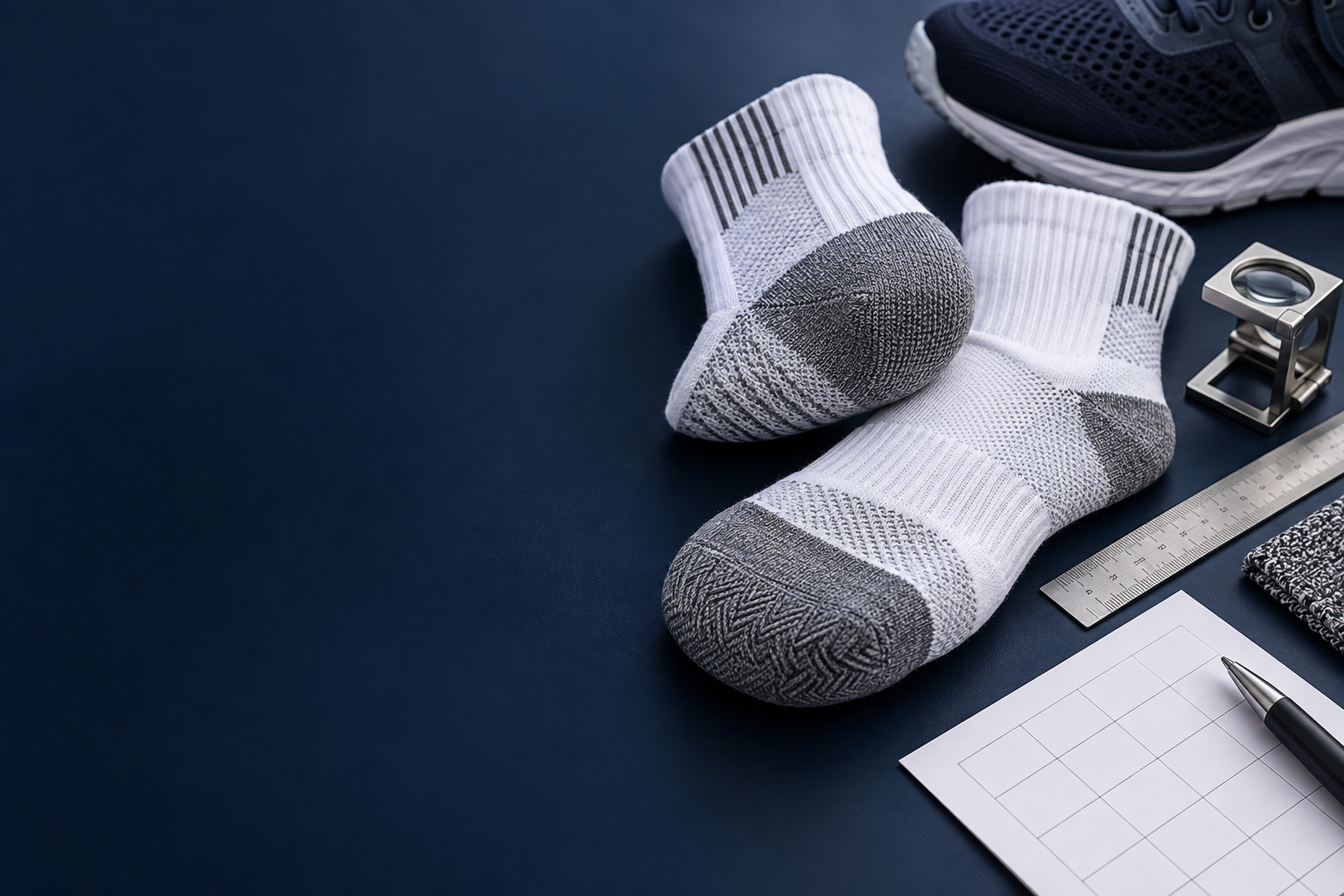
Direct answerPlan heel and toe reinforcement by mapping wear zones, defining the intended construction and comfort, checking interaction with yarn, terry, mesh and footwear, then verifying the result on representative samples. Record the approved location, material direction and inspection criteria before bulk production.
Start with the approved reference
Quality control starts before anyone inspects a pair. Gather the dated product specification, approved reinforcement sample, artwork version, color reference, size breakdown, packaging artwork and purchase-order requirements. A photo from an earlier conversation is not a sufficient substitute for a controlled reference.
Confirm which requirements are fixed and which are allowed to vary. This prevents a reviewer from rejecting an agreed construction detail or accepting a change that was never approved.
- Dated approved sample
- Final specification and artwork
- Color reference
- Size and quantity breakdown
- Packaging and labeling files
Verify identity and assortment first
Before measuring, confirm that the cartons and inner packs contain the correct style, color, size and quantity. Assortment mistakes can make an otherwise well-made sock unsellable, especially when several colorways share similar packaging.
Check pair matching, left/right requirements where relevant, labels, barcodes and pack counts. Record the carton number and reinforcement sample location for every issue so the factory can trace the problem.
- Style and color
- Size assortment
- Pair matching
- Pack quantity
- Carton and label identity
Measure the product consistently
Use the same measurement points defined in the specification: overall length, foot length, cuff height, opening, heel position or other project-specific dimensions. Measure socks in a consistent relaxed state and note the method; stretched measurements are a separate observation.
Do not invent tolerances after seeing the goods. If a tolerance was not agreed, mark the result as a clarification item rather than presenting an unsupported pass or fail.
- Measurement points
- Relaxed and stretched condition
- Size grading
- Agreed tolerances
- Measurement method
Inspect construction and finishing
Check cuff recovery, heel and toe position, toe closing, seam appearance, mesh or terry zones, reinforcement and any grip or support areas against the approved reinforcement sample. Look inside and outside the sock because loose ends or rough finishing may not be visible from the front.
Separate isolated cosmetic variation from repeated construction defects. A repeated issue deserves escalation even when each individual defect looks small.
- Cuff and shape recovery
- Heel and toe construction
- Toe closing and inside finish
- Mesh, terry or reinforcement zones
- Loose yarns and visible defects
Review color and logo execution
Compare the actual sock with the approved color reference under consistent lighting. Screen images are useful for communication but should not be treated as the sole color standard.
Check logo method, position, scale, orientation, edge clarity and legibility on the worn or stretched sock when relevant. Record whether a problem comes from artwork, placement or the knitted surface.
- Color reference
- Logo position and scale
- Edge clarity
- Stretch appearance
- Artwork version
Check packaging before release
Packaging inspection is part of product inspection. Confirm the correct style, color, size, quantity, barcode, label content, folding direction and carton marks. Compare the packed dimensions with the approved packaging direction and shipping plan.
If packaging was developed by BEZENTO or supplied by the customer, the approval record should still identify the final file and responsible approver.
- Pack format
- Label and barcode
- Fold and assortment
- Carton marks
- Final artwork version
Record defects and disposition
Use a defect log with carton or lot reference, defect description, affected quantity, photo and proposed disposition. Classify each item as critical to the order, requiring correction, or acceptable within an agreed appearance range.
Do not approve shipment based only on a verbal promise to fix an issue later. Obtain written confirmation of rework, replacement, credit or acceptance and keep it with the order record.
- Issue ID and location
- Photo evidence
- Affected quantity
- Corrective action
- Written release decision
Separate critical defects from appearance variation
A missing size label, wrong assortment or open seam can affect saleability and should be handled differently from a small shade or texture variation that falls within an agreed range. The specification should define which issues are unacceptable and which require buyer review.
Do not copy an acceptance number from another product without checking whether it fits this sock, construction and market. If no rule exists, record the issue for project-level decision rather than presenting a fabricated standard.
- Saleability risk
- Construction failure
- Assortment error
- Cosmetic variation
- Buyer review required
Plan re-inspection after correction
When goods are reworked or replaced, inspect the affected quantity again and confirm that the correction did not create a new issue in color, pairing, packaging or carton count. Keep the original defect log and add the correction date.
A short re-inspection note is more useful than a general statement that the problem was solved. It tells the buyer what was checked and what release decision was made.
- Affected quantity rechecked
- Correction date
- New photos
- Packaging recheck
- Final release owner
Keep the QC record usable after shipment
Store the final inspection record with the purchase order, approved reinforcement sample and shipment documents. If customer complaints appear later, the record helps separate a athletic sock production issue from a packing, transport or handling issue.
Use recurring findings to improve the next specification. A quality checklist becomes valuable when it captures lessons from actual orders without turning them into unsupported universal claims.
- Approved sample
- Inspection report
- Defect disposition
- Shipment reference
- Lessons for next order
Review the sock in the way it will be sold
A retail multipack, team order and studio product may be inspected differently because their buyers notice different risks. A team buyer may prioritize consistent sizing and assortment, while a retail buyer may focus on presentation, label accuracy and repeatable color.
Define the selling context before inspection so the reviewer knows which details deserve escalation. This does not replace the technical specification; it adds the commercial context needed to prioritize decisions.
Inspect representative pairs from each style, color and size combination. When an order contains several combinations, a single attractive pair cannot prove that every assortment is correct.
Record the inspected combinations and the reason for selecting them. A clear sampling record makes later discussions factual without claiming that a limited check proves every pair is identical.
- Selling channel
- Representative combinations
- Buyer priorities
- Sample selection reason
- Commercial risk notes
Turn inspection findings into supplier feedback
Useful feedback describes the location, condition and required change. ‘Logo looks wrong’ is difficult to act on; ‘logo is 8 mm closer to the cuff than the approved landmark on size M’ gives the factory a clear investigation path.
Include the reference used, the affected quantity and the desired disposition. If the buyer is open to a practical alternative, state that separately from the non-negotiable requirement.
Close the loop by recording whether the factory accepted the finding, proposed rework, supplied replacements or documented an approved deviation. This history improves the next order without turning one project observation into a universal performance claim.
- Precise location
- Reference comparison
- Affected quantity
- Required correction
- Written response
Prepare the final release decision
The release decision should answer four questions: what was inspected, against which reference, what issues remain, and who approved the disposition. A short dated release note is enough when the supporting records are complete.
If goods are released with an agreed deviation, describe the deviation and its scope. Do not silently update the specification after athletic sock production; keep the original requirement and the approved exception visible.
For future orders, convert only verified lessons into checklist items. Keep project-specific observations labelled as such and review them again when the construction, market or packaging changes.
- Inspection scope
- Reference version
- Open issues
- Approved disposition
- Release owner
Use a consistent inspection sequence
A fixed sequence reduces missed checks. Start with identity, then measure, inspect construction, review color and logo, check packaging, and only then decide release. The sequence should be simple enough for a second reviewer to follow.
Photograph the reference and inspected pair together when comparison matters. Record lighting or measurement conditions that could change the observation, and identify whether the issue is isolated or repeated.
If a buyer uses an external inspection team, provide the same specification and approval reinforcement sample. Different reviewers should not be working from different versions of the order.
- Fixed inspection order
- Reference beside product
- Condition notes
- Isolated or repeated issue
- Shared inspection brief
Review in the intended footwear
A flat reinforcement sample check is necessary but not sufficient for an athletic product. Use the intended shoe or a comparable shoe and record whether the sock changes the fit, heel position, toe clearance or feel at the cuff. Review the size that represents the main order and check other sizes when the construction is graded.
If the product serves running, training or team sports, note the activity used during review. The purpose is not to claim a performance result; it is to ensure that the approved construction matches the product brief and does not create an unexpected fit issue.
- Intended shoe
- Representative size
- Heel position
- Toe clearance
- Activity context
Close the sample with a written decision
Use one checklist for every reviewer and mark pass, revise or open decision for each item. Include measurements, photos or comments that allow the factory to identify the location of a problem. Avoid feedback such as make it better; state the zone and requested change.
Approve the reinforcement sample by version, not by memory. Store the approved reinforcement sample, specification, artwork and packaging files together. If a later change affects yarn, construction, size or color, open a new review instead of assuming the old approval still applies.
- Pass or revise
- Evidence attached
- Location-specific feedback
- Version approval
- Change re-review
Map heel and toe wear zones
Mark the heel pocket, heel base, toe box and toe seam on a flat custom sock tech pack. State which area needs a denser, stronger or more protective structure and why. Keep the request tied to the intended shoe and activity so the reinforcement does not create unexpected bulk or pressure.
Review the transition between reinforced and lighter zones. A clear boundary supports inspection, while an abrupt change may affect comfort, appearance or logo placement. Ask the factory to show the proposed map before sampling.
- Heel pocket
- Heel base
- Toe box
- Toe seam
- Transition line
Approve comfort and fit with the shoe
Check the reinforced zones flat and worn. Review heel position, toe clearance, seam feel, thickness and movement inside the intended shoe. A reinforcement decision is not complete when it looks correct on a table but changes fit during wear.
Record the size, shoe and activity used for the review. If a change is needed, identify whether the issue comes from location, thickness, yarn, seam or grading. This gives the factory an actionable revision instead of a general request for more durability.
- Flat check
- Worn check
- Shoe context
- Seam comfort
- Actionable revision
Buyer Questions
What is the first check on an athletic sock sample?
Confirm the sample version, size and construction against the approved brief before reviewing individual features.
Should the sample be tested in a shoe?
Yes. Use the intended or comparable shoe to review heel position, toe clearance, cuff feel and interaction with mesh or terry zones.
How should buyers record defects?
State the location, observation, evidence and requested action, then identify the sample version.
When is a sample ready for approval?
When the buyer has reviewed measurements, construction, fit, logo, color, comfort and packaging, and has recorded any accepted deviations.
Does sample approval cover a material change?
A material or construction change should be reviewed again because it can affect feel, fit, color or production requirements.
Discuss Your Custom Sock Requirements
Send your product type, artwork, quantity, size range, packaging, destination and target date for a practical project review.